
CCTV survey: $300–$750
Stands alone and is credited against the works by most operators. Without it nobody can price a liner honestly.
A cracked or root-damaged drain does not have to mean a trench through the garden. A resin liner is cured inside the existing pipe from an access point you already have, sealing every joint along the run, and the surface above is never touched.
The failure that brings most people here is not a broken pipe. It is a joint. Older drainage is laid in short lengths, so a single run has a great many joints, and after decades of ground movement and root pressure they open a fraction at a time until something backs up.
A liner seals all of them in one pass, which is why it changes the pattern rather than resetting it. Cutting roots out clears the pipe and leaves the way in exactly as it was, and the interval to the next blockage is set by how fast they grow back.
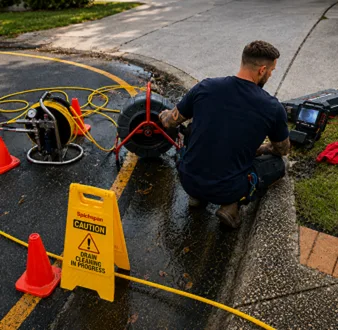
An older house is rarely on one generation of drainage. It is on three or four, joined wherever a bathroom moved or an extension went on, and the transitions between materials are where most faults sit.
A camera run on a property like this is genuinely diagnostic rather than a formality. It is common to find a sound original clay run, a poor 1970s junction, and a modern PVC section all on the same line, each needing a different answer.
Properties on a slope often have long drainage runs, sometimes crossing the whole block to reach the main. The practical questions are where the inspection openings are and whether the liner can be drawn through in one length or needs a second access.
That is worth establishing before quoting. A single long run costs less per metre than the same distance broken into stages, and the difference is decided by access, not by the pipe.
People are often surprised that a drain laid before the war is a relining candidate rather than a replacement. Age alone does not decide it. A clay line with a sound barrel and tired joints is close to the best case for a liner.
The cases that genuinely need excavation are different: a collapsed section, a run that has lost its fall, or a pipe crushed out of round. A camera separates those in an hour, and the answer changes the cost by a multiple.
Removing a mature tree is expensive, often needs approval, and frequently does not solve it: the roots already inside the pipe do not leave when the trunk does, and the joint is still open for the next one.
Cheltenham’s remnant blue gum high forest is beautiful above ground and relentless below, driving roots deep into the joints of ageing sewer lines across the suburb.
Relining lets both things be true at once. The garden stays as it is and the drain stops being a route to water. For most owners that is the whole appeal, and it is why no-dig gets specified on established blocks far more often than on new ones.
A listing does not stop you repairing a drain. What it restricts is change that is visible or that disturbs significant fabric, which is precisely what a trenchless repair avoids.
In practice that makes relining the path of least resistance on a listed or conservation-area property: nothing is removed, nothing changes above ground, and there is no reinstatement to get approved.
Blocks backing onto Lane Cove National Park carry long, steep drain runs where displaced joints and debris build-ups hide until the line suddenly blocks.
Excavating on a slope is a different job from excavating on the flat. Access for a machine is often impossible, the spoil has to go somewhere, trench walls need support, and reinstating a tiered garden or a retaining structure can cost more than the drainage work it was dug for.
Relining sidesteps all of it. The line is repaired from an existing access point, and the surface above stays exactly as it is. On a difficult block the saving is not marginal, it is often the difference between doing the job and deferring it.
Whether a drainage failure is covered varies by policy and by cause, and gradual deterioration is commonly excluded while sudden damage often is not. That distinction is decided on evidence.
Dated camera footage showing the defect, its position and its cause is what an insurer or a strata manager works from. It costs nothing extra to keep and it is impossible to reconstruct later.
Stands alone and is credited against the works by most operators. Without it nobody can price a liner honestly.
The usual Sydney range for domestic sewer. Access and junction reinstatement are normally quoted separately.
One defect in an otherwise sound run. The proportionate answer on stable ground, and the wrong answer on a line with twenty tired joints.
Where the camera shows the same failure repeating along the length. Ends the problem rather than relocating it.
The honest comparison. Cheaper on an open lawn, rarely cheaper under a driveway, paving or a building.
Figures reflect the 2026 Sydney market rather than a quote. You get your own number once we have seen inside the pipe. Figures here are indicative of the 2026 Sydney market rather than a quote from us, you get your own number as a fixed price before any work starts.

Nothing is priced until a camera has been down the line. The survey is recorded, distances are marked from a known point, and the footage is yours.
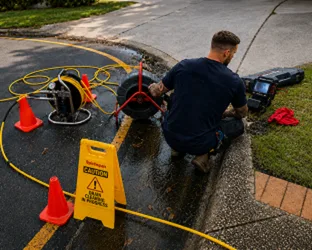
A single defect in a sound run wants a patch. A run failing along its length wants a full liner. A collapsed or sagging section wants excavation. The camera decides, not the quote.
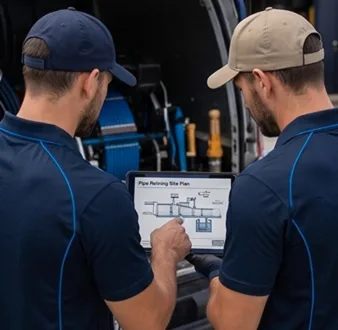
Jet clean, install through the existing opening, cure in place. Water is off for part of the day and nothing above the pipe is disturbed.

Junctions reinstated, final camera run, and the compliance paperwork where the work is notifiable. You keep both recordings.
Describe what the drain is doing and how often. We will tell you whether it sounds structural or whether a clean and a maintenance interval is the honest answer.
The questions that come up before every relining job, answered with real numbers.
Phone is quickest. The form reaches the crew covering Cheltenham, and the first step is always the survey.

Leave your details and our local Cheltenham team will call you back fast.